A joint whitepaper proposing an operational and financial framework for managing enterprise AI inference transactions
From API Request to General Ledger

Date
Author
Lawrence Xu (Infron) and Jian Zhang (CFEX)
Enterprises increasingly source intelligence from a portfolio of models and compute providers, including frontier models, specialized models, open-source models, and compute resource suppliers. Some are sourced directly; others come through inference infrastructure providers or third-party hosting services to run AI applications, creating a complex inference supply chain.
Infron and CFEX provide an integrated inference operations platform to manage the full lifecycle of these inference transactions: Source, Control, Account, Settle, and Optimize. Infron manages how enterprises source, access, and control inference at runtime. CFEX accounts for revenue and costs based on commercial contracts and settles the resulting financial obligations with customers and suppliers. Optimization closes the loop: CFEX helps optimize contract economics at negotiation time, while CFEX and Infron together support cost-optimized routing at runtime.
Why inference requires a new operational and financial framework
AI inference is fundamentally different from traditional SaaS procurement. With SaaS, an enterprise typically knows its cost when it signs a subscription agreement. Cloud infrastructure introduced more usage-based economics. However, inference introduces another level of complexity. First, unlike traditional SaaS, inference can carry significant Cost of Goods Sold (COGS) because every request consumes model and compute resources. Managing inference costs can therefore be as important as managing revenue.
Second, enterprises may source intelligence from a model based on contracts, which may include terms such as token pricing by type, cached-token pricing, GPU consumption, reserved capacity, commitments, prepaid credits, tiers, discounts, rebates, overages, and true-ups. Costs are determined by both granular usage and negotiated contractual terms. As a result, there may be several economically meaningful costs for the same inference consumption:
List price: the provider’s published price.
Effective cost: what the enterprise actually pays after applying commitments, discounts, credits, rebates, and other contractual terms.
Marginal cost: the incremental economic cost of the next unit of inference given the current state of the contract.
Finance needs effective cost. Routing needs marginal cost. Procurement and contract negotiation need both. Consider an enterprise with a $1 million annual commitment that has consumed only $800,000 as the contract approaches expiration. If the remaining $200,000 is forfeited when the term ends, consuming the next $200,000 under that contract may create no additional financial obligation. A competing model with a lower published token price could therefore actually have a higher marginal cost.
Third, enterprises increasingly source intelligence from many different models through multiple commercial relationships. Some models are contracted directly, others are accessed through inference infrastructure providers such as Infron, and open-source models may be self-hosted or hosted by third-party compute providers. The same model may even be available through multiple supply paths, each governed by different commercial terms and therefore carrying different effective and marginal costs.
Together, these characteristics make inference not just a technical workload, but a transaction lifecycle that must be sourced, controlled, accounted for, settled, and continuously optimized.
The Inference Transaction Management Lifecycle
Inference transactions undergo five interconnected stages spanning operational, financial, and analytical processes: Source, Control, Account, Settle, and Optimize. Together, Infron and CFEX support this complete lifecycle.
Stage | Primary role | What it answers |
|---|---|---|
Source | Infron | Where should we source intelligence, from which models and providers, and under what contractual terms? |
Control | Infron | Who can consume inference, how much, and under what runtime controls? |
Account | CFEX | How much have we earned under each sales contract, and how much do we owe under each supply contract? |
Settle | CFEX | How do we bill and invoice customers, reconcile invoices from suppliers before payment, and book revenue and expenses to ERP through the general ledger? |
Optimize | Infron/CFEX | How do we optimize inference revenue, costs, and margins at contract negotiation time and runtime? At contract negotiation time, CFEX simulates revenue and costs under alternative commercial terms against historical or forecast usage to optimize commitments, pricing, credits, discounts, and other contract economics. At runtime, CFEX calculates contract-based effective and marginal costs, which can inform Infron’s routing alongside its real-time price, latency, and throughput signals. |

Figure 1. The inference transaction lifecycle. Infron manages sourcing and runtime controls; CFEX accounts for and settles each contract; optimization closes the loop.
Infron: Managing Operations of Inference Transactions Across the Inference Supply Chain
Enterprises increasingly use a variety of models to meet their inference needs, ranging from large frontier models to small specialty models and from closed-source to open-source models. Many enterprises maintain direct agreements with their largest model providers while using self-hosted open-source models and third-party services for the long tail.
Access: Infron puts 400+ models behind one API and one commercial relationship.
Billing: consolidated billing across providers, and credits never expire. The enterprise plan adds invoicing and volume discounts of up to 30%.
Own provider keys: models an enterprise contracts directly can run through Infron with its own keys (BYOK) at 0% platform fee. Infron uses those keys first, then falls back to its shared capacity.
Routing: by default, Infron weighs price, latency, throughput, and reliability across providers in real time, with automatic fallback.
Runtime spend controls
Infron’s spend controls apply at each API request, not after the fact.
Budget levels: team, member, and API key, for example one per business unit, employee, and application.
Limits: team budgets are always hard and block new billable requests. Member and key budgets can be soft (alert only), hard, or unlimited. A request must pass every applicable hard limit.
Alerts: at 50%, 80%, and 100% of each budget.
Roles: admins set team and member budgets. Billing managers view usage and manage top-ups and invoices, but cannot change budgets, create API keys, or change roles.
Infron budgets govern billable traffic through Infron. Traffic sent through an enterprise’s own provider keys or directly to other suppliers can still be accounted for by CFEX at the financial layer.

Figure 2. Enterprises keep direct agreements with their largest providers. Infron brings the long tail behind one API. The same model, such as DeepSeek, can reach an enterprise through more than one supply path.
CFEX: Contract-Based Financial Operations Across the Inference Supply Chain
Every API transaction can ultimately create a financial obligation between a buyer and seller across the inference supply chain. The obligation may depend on the specific commercial contract governing the transaction - including token rates, cached-token pricing, reserved capacity, minimum commitments, prepaid credits, tiers, discounts, rebates, overages, and true-ups.
CFEX determines revenue based on sales contracts and costs based on supply contracts.
CFEX’s Contract Rule Engine models complex commercial terms as configurable financial rules rather than custom software, enabling CFEX to determine receivables and revenue from customers and payables and costs to suppliers based on contractual terms.
Revenue: CFEX’s Contract-Based Billing System models sales contracts, calculates revenue, automates billing and invoicing, and supports revenue operations.
Costs: CFEX’s Inference Cost Engine models contracts with model, compute, and inference infrastructure providers; calculates actual, effective, and marginal costs; accrues financial obligations; allocates costs; and independently reconciles supplier invoices.
The same financial operations platform can serve every participant across the supply chain
CFEX can be leveraged by every participant in the inference supply chain to track both revenue from customers and cost obligations to suppliers.
For an enterprise, CFEX can model its agreement with Infron, its direct contracts with model and compute providers, and its contracts with third-party open-source model hosting providers, providing a consolidated view of financial obligations across its inference suppliers.
For Infron, CFEX can model both sides of its commercial relationships: sales contracts with customers or channel partners to track revenue, and supply contracts with model and compute providers to track costs. CFEX automates customer billing and invoicing using sales contract models and reconciles supplier invoices based on supply contract models.
More broadly, this architecture can support bilateral financial relationships across the inference supply chain wherever metered transactions are governed by commercial contracts.
Attribution and allocation of inference costs to cost centers
CFEX applies contractual terms to transaction and usage data to calculate and allocate inference costs to employees, projects, departments, applications, agents, and business units. Costs can therefore be attributed and tracked as they accrue rather than waiting for supplier invoices at month-end. CFEX tracks budgets for each account and can notify designated stakeholders when configurable thresholds are reached.
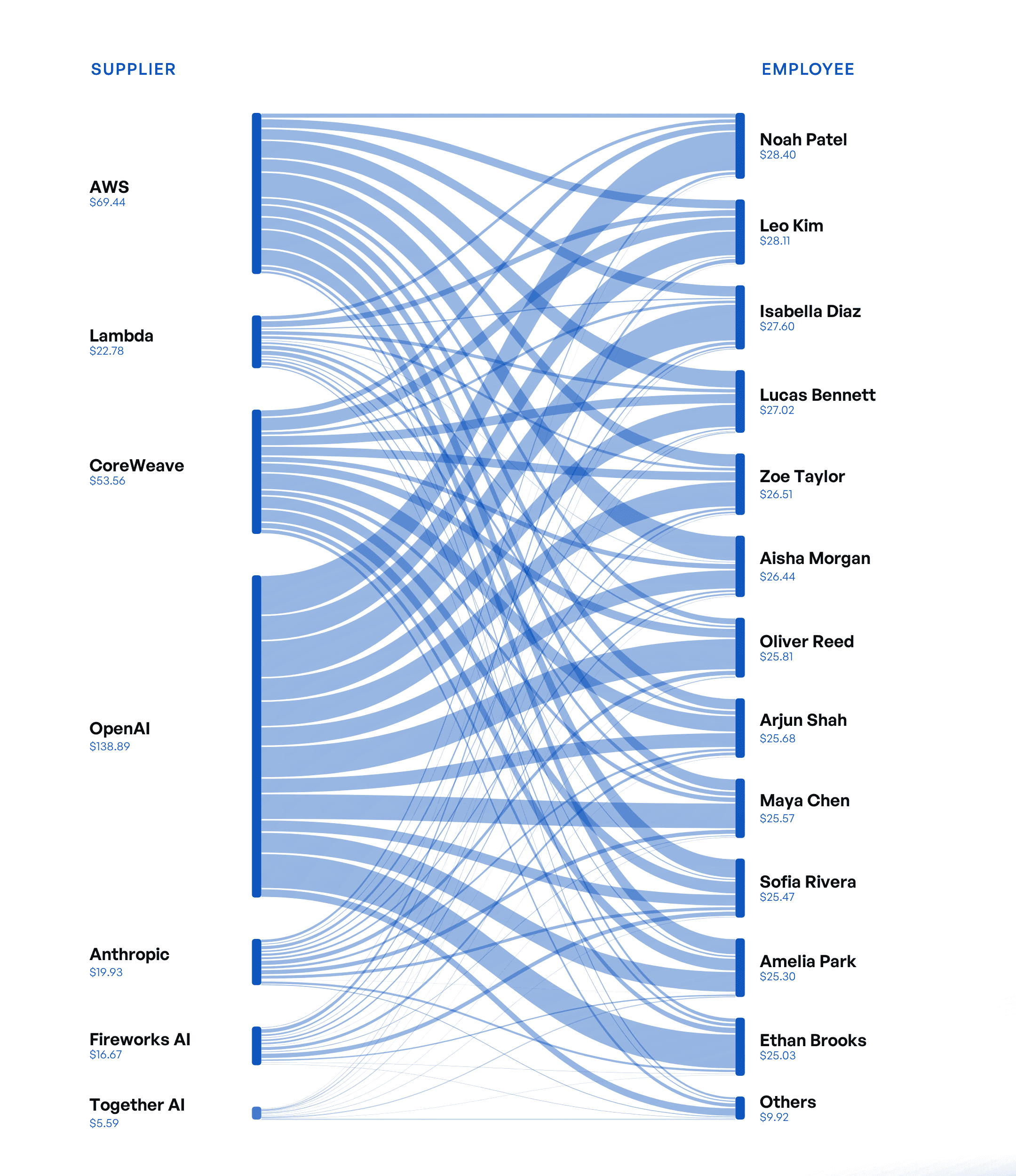
Figure 3. Allocation of inference costs to employees. Illustrative data.
Benefits of Integrated Inference Operations Platform for Enterprises
By holistically managing the operational and financial aspects of inference transactions, the integrated Infron and CFEX platform enables enterprises to manage inference operations across their lifecycle, spanning inference sourcing and access, runtime controls, contract-based accounting and financial settlement, and optimization.
Unified Inference Supply and Access — Manage inference across direct model providers (through BYOK), open-source models from multiple hosting providers, and 400+ long-tail models, with Infron providing a unified API and commercial relationship for aggregated supply.
Runtime Governance and Spend Control — Control who can consume inference and enforce budgets at the point of API request by team, member, and application, while maintaining appropriate roles for engineering and finance.
Contract-Based Billing — Apply sales contract terms to actual usage to accrue revenue and receivables daily and automate customer billing and invoicing.
Contract-Based Supplier Settlement — Apply supply contract terms to actual usage to accrue costs and payables daily, independently calculate expected charges, and reconcile supplier invoices before payment.
Runtime Cost Management and Optimization — Calculate actual, effective, and marginal inference costs; allocate them across business units, projects, products, agents, and employees; track them against budgets; and provide cost signals to model routers for cost-optimized routing.
Contract and Economic Optimization — Track commitments and credits, simulate alternative contractual terms against historical or forecast usage, improve customer and supplier contract negotiations, and optimize revenue, costs, and gross margins.
From API request to general ledger
Every inference request represents a transaction across the AI inference supply chain. Managing these transactions requires operational capabilities to source and control inference, financial capabilities to account for and settle contractual obligations, and optimization capabilities to continuously improve their economics.
Infron and CFEX together support this complete inference transaction lifecycle: Source, Control, Account, Settle, and Optimize. Infron manages inference sourcing and runtime controls. CFEX manages contractual accounting and financial settlement. CFEX helps optimize contract economics at negotiation time, while CFEX and Infron together enable contract-based cost intelligence to support cost-optimized routing at runtime.
Together, Infron and CFEX provide an integrated operational and financial infrastructure for managing inference transactions across the AI supply chain.